Commercial Holiday Lighting in Chandler, Gilbert & Mesa: ROI, Examples, and Timelines
What it costs, how long it takes, and how to know it paid off
Most East Valley businesses spend somewhere between $1,500 and $50,000 or more on professional holiday lighting, depending on property size and scope. Lights typically go up between late October and mid November, run through New Year's, and come down in early January. For a retail center or restaurant, the lighting usually pays for itself if it brings in a handful of extra customers per night during the busiest spending weeks of the year.
If you manage a retail center, office park, or restaurant in Chandler, Gilbert, or Mesa, you already know December can make or break the year. What you might not have is a clear way to decide whether professional holiday lighting is worth the line item, what it should cost, and when you need to start.
This guide answers those questions the way a property manager or owner would actually ask them. We cover the return you can reasonably expect, the projects that make the most sense on East Valley properties, a realistic timeline from walkthrough to takedown, budget ranges by property size, and the approval and insurance questions that come up on almost every commercial job.
What is the ROI of holiday lighting for retail centers in Gilbert?
The honest answer is that it depends on your traffic, your tenants, and how visible the property is from the road. You will see plenty of big percentage claims online, but most of them come from lighting companies and are hard to verify. A better approach is to run the break even math for your own property. It is usually a lot smaller than people expect.
Example break even math for a neighborhood retail center
| Input | Example Number |
|---|---|
| Holiday lighting investment | $8,000 |
| Average customer ticket across tenants | $40 |
| Average gross margin | 40% (about $16 per visit) |
| Extra visits needed to cover the lighting | 500 visits |
| Season length (Thanksgiving week to New Year's) | About 40 nights |
| Extra visits needed per night | About 13 across the whole center |
Example math only, not a promise of results. Plug in your own ticket size and margin.
Spread across a center with 10 to 12 tenants, that is roughly one extra customer per store per night. For a restaurant with a $90 average table, the number drops even further. That is why lighting tends to pencil out for properties on busy roads like Chandler Boulevard, Gilbert Road, or Power Road in Mesa, where thousands of cars pass every evening after dark.
Returns that do not show up on the register
- Tenant retention. Tenants notice when a landlord invests in the property during their most important season. It is an easy win heading into lease renewals.
- Leasing appeal. Prospective tenants who drive by in December see an active, cared for center instead of a dark one.
- Visibility and safety. Short winter days mean customers are arriving and leaving in the dark. More light around entries and parking areas makes the property feel safer.
- Free social media reach. A good display gets photographed and posted, which puts your property name in front of local customers at no cost.
How to measure whether it worked
Pick two or three numbers before the lights go up so you have something to compare. Good options are December sales versus last December, door counter or reservation data, and the calls, direction requests, and photo views in your Google Business Profile for November through January. If you track the same numbers every year, you will know within one season whether the lighting is pulling its weight.
What commercial holiday lighting projects work best in the East Valley?
Most commercial properties do not need every surface lit. The best results come from putting light where drivers and customers actually look. These four project types cover the majority of commercial work we see in Chandler, Gilbert, and Mesa.
Monument Sign Lighting
Your monument sign is the first thing drivers see, and it is often the cheapest place to make a big impression. Outlining the sign, adding wreaths or garland, and uplighting the surrounding landscaping makes the property easy to spot from the road.
Good fit for: retail centers, office parks, HOA entrances, churches
Parking Lot Trees
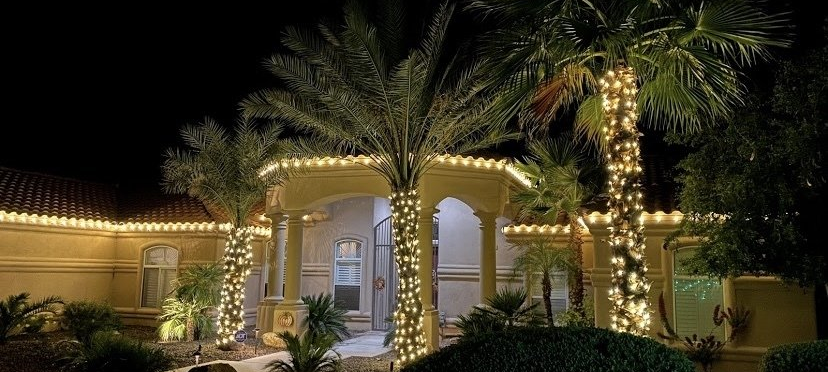
Wrapping the trunks and canopies of parking lot trees fills a dark lot with warm light and gives the whole center a festive look. Palo verde, mesquite, and pistache trees take canopy wraps well, and palm trunks can be wrapped in rows for a clean look.
Good fit for: shopping centers, strip centers, medical plazas
Restaurant Patios and Entryways
Patio season in the East Valley runs right through the holidays, which makes the patio your best advertising. Overhead lighting, lit garland on railings, and a framed entry give guests a reason to choose your spot and take photos while they are there.
Good fit for: restaurants, bars, coffee shops, breweries
Office Park Entrances
For office parks, the goal is a polished, professional look rather than a big show. Lighting entry columns, the main building roofline, and a few feature trees signals a well managed property to tenants, visitors, and anyone touring space.
Good fit for: office campuses, business parks, professional plazas
Want to see the full range of commercial services? Visit our commercial Christmas lights page.
What does a commercial lighting project look like in Chandler, Gilbert, and Mesa?
Here is how three common project types usually come together, from scope to install time.
Neighborhood Retail Center
Scope: monument sign outline, canopy wraps on parking lot trees along the main drive, and warm white lights on the main building roofline.
Install: usually two to three nights, scheduled after the last tenant closes so the lot is clear.
Budget tier: medium
Restaurant With a Patio
Scope: overhead patio lighting, lit garland on the railings, a framed front entry, and a couple of wrapped trees near the door.
Install: usually one morning before opening, with all cords run clear of walkways and server paths.
Budget tier: small to medium
Office Park or Business Campus
Scope: entry monument, column wraps at each main building entrance, and a few feature trees near the visitor lot, all on timers.
Install: one to two days, worked around tenant hours with the property manager.
Budget tier: medium to large
These are typical project profiles to help you plan. Every property gets its own design and quote after a site walkthrough.
How long does a commercial holiday lighting project take from start to finish?
Plan on about three to four months from the first walkthrough to takedown, with most of the work happening behind the scenes. The East Valley calendar has a few quirks worth knowing. Monsoon storms usually wind down by the end of September, October afternoons can still be hot enough to push crews into early morning shifts, and commercial clients want lights on before the Thanksgiving weekend rush.
- 1
Site walkthrough and design
August to early OctoberWe walk the property, note power sources, tree sizes, roof and parapet details, and sightlines from the main road, then put together a design and quote.
- 2
Approvals and scheduling
One to two weeksThe proposal goes to ownership, the HOA, or the landlord as needed. Once approved, we lock in install dates and send over any insurance paperwork your management company requires.
- 3
Installation
Late October to mid NovemberMost commercial installs take one to five nights or early mornings depending on size. We work around business hours so customers and tenants are not dealing with ladders and lifts.
- 4
Lights on and in season service
Thanksgiving week through New Year'sLights run on timers so nobody has to remember to flip a switch. If a section goes out or a winter wind storm knocks something loose, you call us and we come fix it.
- 5
Takedown and storage
First half of JanuaryWe remove everything, check the property for any clips or ties left behind, and pack the lights for next season.
Booking tip: commercial install calendars fill fast once October hits. If you are reading this in the fall, request your walkthrough now rather than waiting until November.
How much does commercial Christmas lighting cost in Chandler?
Commercial pricing is quoted per property because no two sites are the same. That said, most East Valley projects fall into one of three budget ranges. These cover design, materials, installation, in season service, and takedown.
| Property Size | Typical Scope | Typical Budget |
|---|---|---|
| Small | Single storefront, restaurant entry and patio, or one monument sign with landscaping | $1,500 to $5,000 |
| Medium | Strip center, restaurant with large patio, or office park entry with feature trees | $5,000 to $15,000 |
| Large | Shopping center, multi building campus, or HOA with several entrances | $15,000 to $50,000 and up |
What moves the price up or down
- Lift access. Tall trees and two story rooflines often need a boom lift, which adds equipment cost.
- Tree count and size. Full canopy wraps take far more lights and labor than trunk wraps.
- Linear feet of roofline. Longer runs mean more product and more install time.
- Power availability. Properties with outdoor outlets near the work area cost less than ones that need extra power planning.
- After hours work. Overnight installs are common for commercial jobs and are factored into the quote.
If you want lighting that stays up all year and can switch from holiday colors to game day or everyday white, permanent holiday lighting is worth comparing. It costs more up front but removes the yearly install and takedown.
Which East Valley cities do you serve for commercial lighting?
Holiday Lights Phoenix is based in Ahwatukee and handles commercial projects across the East Valley and the greater Phoenix area, including:
Commercial holiday lighting questions from property managers
Often, yes. Many East Valley HOAs and commercial landlords have rules about decorations, attachment methods, and timing. We provide a written design with photos and mounting details so your board or landlord has what they need to sign off quickly.
Ask for a certificate of insurance showing general liability and workers' compensation before any work starts. Many management companies also ask to be listed as additional insured. We send insurance paperwork during the approval step so it never holds up the install date.
Yes. Most commercial installs are done overnight or in the early morning. We coordinate with the property manager on access, lot closures, and any tenant notices ahead of time.
Most commercial clients prefer that we handle storage so they do not lose closet or warehouse space. The lights are removed, packed, and kept ready for the next season's install.
Call us and we will send a tech to fix it. Service calls during the season are part of a professional install, so you are not stuck with a dark section during the busiest weeks of the year.
In most cases, yes. During the walkthrough we map out the outdoor outlets and existing landscape lighting circuits, then plan the design around them. Every display runs on timers so the lights come on at dusk without anyone on site.
The best time to book is August through early October. That leaves room for approvals and gets your property on the install calendar before the November rush. Later bookings are sometimes possible but dates are limited.
Pricing in Mesa is in line with Chandler and Gilbert. Small properties typically run $1,500 to $5,000, medium properties $5,000 to $15,000, and large centers or campuses $15,000 and up. The exact number comes after a site walkthrough.
Request a Commercial Site Walkthrough in the East Valley
Tell us about your property in Chandler, Gilbert, Mesa, or nearby. We will walk the site, design a display that fits your budget, and get you on the install calendar.